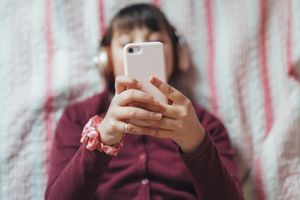
Australian has become the world's first country to implement a social media ban for under-16s.
Ten of the biggest social media platforms were ordered to implement the ban from midnight on 10 December local time (1pm GMT on Tuesday) or face fines of up to AU$49.5m (£25m).
As the legislation comes into effect, the companies need to find ways to close existing accounts belonging to under-16s and stop new ones from being created.
Australia's eSafety Commissioner Julie Inman Gran said the restrictions "aim to protect young Australians from pressures and risks that users can be exposed to while logged in to social media accounts".
She added: "These come from design features that encourage them to spend more time on screens, while also serving up content that can harm their health and wellbeing."
The law is designed to protect children from potential mental health risks, cyber-bullying, and inappropriate content.
Australia's 2021 census showed there are roughly 2.5 million eight to 15-year-olds in the country, and the government has estimated that 86% of people in the age bracket use social media.
Which platforms are affected?
The platforms which are now age-restricted include:
• Facebook
• Instagram
• Snapchat
• Threads
• TikTok
• Twitch
• X
• YouTube
• Kick
More generally, age restrictions will apply to social media platforms that meet three specific conditions, unless the Australian government determines they should be excluded.
The conditions are:
• The sole purpose, or a significant purpose, of the service is to enable online social interaction between two or more users
• The service allows users to link to, or interact with, some or all of the other end-users
• The service allows users to post material on the service
Platforms are responsible for determining whether they fit the criteria and doing their own legal assessments.
What apps are not age-restricted?
The country's eSafety Commission has said the following platforms will not be age-restricted:
• Discord
• GitHub
• Google Classroom
• LEGO play
• Messenger
• Pinterest
• Roblox
• Steam and Steam Chat
• WhatsApp
• YouTube Kids
ESafety determined the list on 21 November, and said "there are no further assessments planned in the lead up" to the implementation of the ban.
However, the Australian government has indicated that the list could change as new products emerge and young
users switch to alternatives.
Read more:
New law targets AI-generated child sex abuse images
What you can't say in online posts
Backlash against internet safety rules
How will social media companies comply with the ban?
Australia's Online Safety Amendment Act 2024 requires companies to take "reasonable steps" to stop underage users from signing up and using their platform; they could face fines of up to $49.5m (£25m) for failing to comply.
Of the initial 10 banned platforms, all but Elon Musk's X have said they will comply using age inference. This involves guessing a person's age from their online activity - or age estimation, which is usually based on a selfie.
They might also check with uploaded identification documents or linked bank account details.
However, the Australian government has said that requesting ID cannot be the only way to determine someone's age.
Meta - which owns Facebook, Instagram and Threads - said in submissions to the Australian government last year that the legislation was "a missed opportunity and overlooks the practical reality of age assurance technology as well as the views of a majority of mental health and youth safety organisations in the country".
The company, chaired by Mark Zuckerberg, started to exclude suspected young children from its platforms a week before the ban came into force, but admitted previously that it expects issues with its technology, which could result in accounts belonging to people who are actually over 16 accidentally being shut down.
Meta previously confirmed that its users aged 13 to 15 would receive in-app messages or texts informing them their Facebook, Instagram and Threads accounts would be removed as early as 4 December. It said it would rely on age-estimation systems.
TikTok said in a statement that it will have a "multi-layered approach to age assurance," while Snapchat will use behavioural signals to estimate ages.
Is the move controversial?
Before Australia's parliament passed the ban last year, more than 140 national and international academics with expertise in fields related to technology and child welfare signed an open letter to Prime Minister Anthony Albanese opposing a social media age limit as "too blunt an instrument to address risks effectively".
In Sydney, two 15-year-olds have gone as far as to sue the Australian government over the ban.
One of the claimants, Noah Jones, who turns 16 in August, has argued the ban will deny 2.6 million young Australians of a right to freedom of political communication implied in Australia's constitution.
As Meta did in its submissions to the Australian government, several other platforms also criticised the move.
Google and YouTube Australia's public policy senior manager, Rachel Lord, said the site will automatically sign out users who are deemed to be under 16.
But, she said, they can still watch some YouTube videos while signed out, and parents will "lose their ability to supervise their teen or tween's account" and use controls such as blocking channels.
Australia's communications minister Anika Wells responded, saying it was "outright weird that YouTube is always at pains to remind us all how unsafe their platform is in a logged out state".
There has also been criticism of the government for excluding popular apps, particularly Yope and Lemon8, which were in the top 30 on the Australian iOS App Store at the beginning of December, as kids look for alternatives.
Ms Wells told Australian media: "If we find that because they've been logged out of Snapchat, Instagram, TikTok [or] what have you, they end up on Lemon8, then we will look at whether the harm has transferred there and whether we need to add them to the list."
Sussan Ley, leader of the opposition in Australia, said she has "no confidence" that the social media ban will work.
Could the UK introduce a similar ban?
While Australia is leading the way in legislating age-restriction rules on under-16s, the UK is also navigating this type of discussion.
The government brought in the Online Safety Act in July, saying "the way children experience the internet will fundamentally change".
This included age restrictions effectively banning under-18s from seeing "the most harmful material on social media and other sites".
The law is aimed at stopping children from watching "harmful content" including pornography, self-harm, suicide, hate speech and violence.
Andy Burrows, chief executive of the Molly Rose Foundation, which was set up after 14-year-old Molly took her own life after viewing thousands of images promoting suicide and self-harm, said the UK can do "so much better" than an Australia-style ban.
Calling the law "flawed", he said instead of eliminating harm, the ban will see online threats and "bad actors" migrate to gaming and messaging sites, which are still accessible to teens.
"The right answer is a safety and wellbeing by design approach to regulation that gives young people safe use of technology throughout their teens rather than them facing a cliff edge of harm on unregulated platforms when they turn 16," he said.

(c) Sky News 2025: Australia's under 16s social media ban: How it works and could the UK bring in a similar law?
 There's one big problem with Australia's social media ban
 Do you have ringing in your ears? For millions who do, there could now be a solution
 Patients with previously untreatable blood cancer now disease-free after world-first gene therapy
 New mpox strain discovered in England



 On Air