
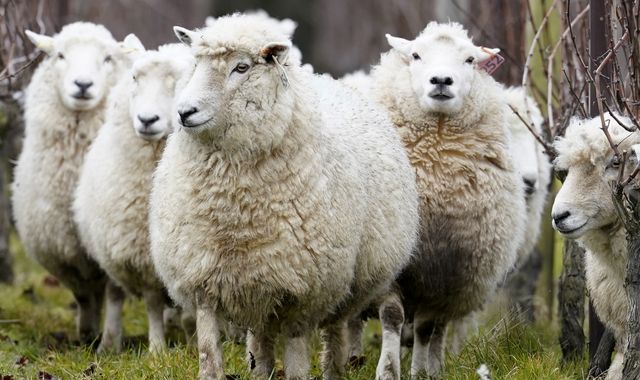
Bluetongue has been detected on a second farm in Scotland and three other suspected cases are being investigated after the nation's first-ever case was recorded at the weekend.
The potentially deadly disease, which affects ruminant livestock like sheep and cattle, was first detected at the Johnson family's Kirkmabreck Farm in Dumfries and Galloway on 8 August.
A single lamb tested positive.
Two more cases of bluetongue serotype 3 (BTV-3) have now been confirmed at another neighbouring farm in south-west Scotland.
The nation's chief veterinary officer, Sheila Voas, said two sheep were infected.
She added: "Both farms are under restriction while investigations, including testing other susceptible animals, are ongoing.
"Vaccination remains the best way of preventing disease in animals and I encourage all farmers to discuss this with their vets."
All three animals have been euthanised.
National Farmers' Union (NFU) Scotland said a further three suspected cases are currently under investigation - two in the same area, including one premises bordering the original case, and one in Fife.
In an update on Facebook, the Johnson family said the rest of Kirkmabreck Farm's stock had tested negative for the disease.
The post added: "Obviously that's not so say we will not have any further cases but for the time being the rest are okay and can return [to] grazing as they should.
"We will still be under movement restrictions [understandably] and will hear, hopefully in the next few days, how long they will remain in place.
"But for now at least we can breathe a sigh of relief that we caught it early and hope and pray that our neighbours remain unaffected."
Bluetongue - an insect-borne viral disease - does not affect humans or food safety.
It is mainly spread by biting midges, although it can also be spread by natural or artificial breeding, and through the placenta from mother to their offspring.
It is a notifiable disease, meaning any suspected cases are legally required to be reported to the Animal and Plant Health Agency (APHA).
Symptoms include nasal discharge, redness and swelling of the lips, nose and muzzle, lameness or reluctance to stand, decreased milk production and diarrhoea in cattle.
NFU Scotland said: "A further three suspected cases are currently under investigation, two in the same area, including one premises contiguous to the original case, and one in Fife.
"While it remains too early to determine the full extent of BTV-3 in Scotland, these latest results mean the situation is developing and underline the importance of continued vigilance, surveillance and testing."
Read more from Sky News:
Relive eclipse with stunning images
A spokesperson added: "Our message on vaccination remains clear. We strongly encourage livestock keepers with susceptible animals to speak to their vet about vaccination, with those in the south of Scotland taking particular priority.
"We are aware that availability of vaccine is currently a concern for some producers.
"The Scottish government is engaging with vaccine manufacturers over potential additional supplies, and NFU Scotland is working to establish the level of demand from livestock keepers across the country."

(c) Sky News 2026: Deadly bluetongue detected on second farm in Scotland - as three more suspected cases investig

 Couple who 'offered sexual services' before drugging and killing two men jailed
 Q2 GDP slows but economy resilient despite Iran war - ONS data
 EFL board holds talks about Premier League's £1.5bn bid to avert watchdog's 'backstop' deal
 Man dies after bungalow destroyed in suspected gas explosion in Buckinghamshire
 102-year-old man dies after alleged assault at pub







 On Air