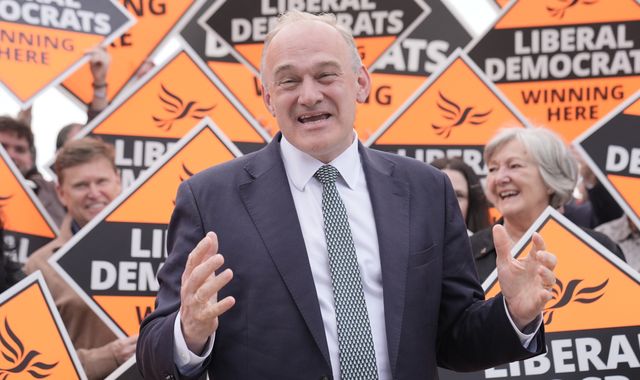
Sir Keir Starmer's departure means Sir Ed Davey, in post since early 2020, is now the longest-serving national party leader.
The headline polling numbers give one cause for concern.
The Liberal Democrats are polling lower now than a year ago with every pollster. On average, the party are down over two percentage points from 12.7% to just over 10.3%, substantially below their vote share in the last general election (12.6% GB wide).
There is some evidence that a resurgent Labour are squeezing the Lib Dems. The party's poll numbers are notably weaker since Andy Burnham became prime minister.
But the Lib Dems were already on the slide when Burnham arrived - they regularly posted shares above 15% in 2025 YouGov polls but have not hit this level with the pollster since early January 2026.
Leader approval
In September 2025, an average of 22% of those polled approved of Davey's leadership, and 28% disapproved, giving a solid but unspectacular net approval of -6. A year later, those figures have barely moved: 21% approve, 28% disapprove, -6 net approval on average.
These figures can be viewed two ways. The optimist's take is that voters have not turned against Davey, even as voter approvals of three other leaders - Sir Keir Starmer, Nigel Farage, and Zack Polanski - have slumped.
Yet while Davey hasn't annoyed voters, he hasn't impressed them either. Low and flat approvals and high "don't knows" suggest a leader who is failing to cut through.
Davey gets positive marks from just a fifth of voters. That's not great. And after more than six years as party leader, nearly half of voters are unable even to offer a view on Davey. That's not great either.
Liberal Democrat leaders typically struggle for a hearing at mid-term, squeezed out by bigger, louder parties. The task may be even harder now in a more fragmented and polarised media and political environment. And a lack of definition can be a plus, giving a leader a chance to (re)introduce himself to voters when the general election arrives.
Past Lib Dem leaders Paddy Ashdown, Charles Kennedy and Nick Clegg all made big gains during the short campaign. This happened to Davey too in 2024. Davey's current lack of definition may work in his favour once voters begin comparing him with more divisive alternatives in a short campaign.
Davey does not, however, do brilliantly in straight comparisons with other leaders. YouGov has occasionally asked which of various pairs of leaders they would prefer as prime minister. Davey does well against radicals. His lead over Reform leader Nigel Farage and Green leader Zack Polanski on this question has grown over the past year or so.
But Davey struggles in matchups against the current leaders of the traditional governing parties. He does much worse against the new Labour leader Andy Burnham than he did against Sir Keir Starmer a year ago.
Davey trailed Starmer by just seven points on the best PM question; he now polls 35 points behind Burnham. Davey beat Conservative leader Kemi Badenoch by eight points in "best PM" matchups a year ago. He now trails the Tory leader by a similar margin.
It is the decline in Davey's ratings versus Badenoch which will most worry Liberal Democrat strategists. The Conservatives are the main competitor to the Lib Dems in most of the seats the party currently holds or is targeting. A year ago, the Lib Dem leader was a clear campaigning asset.
His value added is less obvious today.
Election performance
This was a good year once again for the Lib Dems in local elections. The party made a net gain of over 150 council seats and made a net gain of three councils, with both of the newly created unitary authorities governing Surrey, where they have several target seats, among those gains.
The Lib Dems have made gains in every set of local elections held since Davey took over as leader. This six-year advance has clawed back almost all the ground the Lib Dems lost in their post-Coalition collapse. The Lib Dems now have more councillors, and a higher share of all councillors, than in any year since 2010.
Local by-elections provide further evidence that the Lib Dem campaigning machine is now in rude health, with substantial net gains between the 2025 and 2026 local elections, and again since the 2026 local elections.
This long, strong run of success in council contests will be encouraging for a party which has long used local government as a springboard to Westminster success.
The Scottish Parliament election was another bright spot. The Lib Dems won seven constituency seats and three list seats, and their resulting ten MSPs is their biggest Holyrood cohort since 2007.
The Lib Dems regained three seats with historical sympathies to the party: Caithness, Sutherland & Ross; Skye, Lochaber & Badenoch and Edinburgh Northern. More remarkably, they came from fourth place to win Strathkelvin & Bearsden, a constituency where the party had never previously finished in the top two.
The Welsh Senedd elections were more disappointing. The Welsh Liberal Democrat leader Jane Dodds remains the only Lib Dem in the Senedd.
Her party was unable to profit either from an expanded Senedd using a more proportional regional list PR electoral system, or from the decline of the hitherto dominant Welsh Labour party.
The Lib Dems' overall vote barely rose, and they didn't come close to the threshold for representation in any of the other six seat Senedd constituencies. Outflanked on the nationalist left by Plaid Cymru and the unionist right by Reform UK, the Lib Dems remain confined to the margins of politics in Wales, once a bastion of Liberal support.
In the last Parliament, Sir Ed Davey benefitted from a series of Westminster by-elections triggered in Conservative seats where the Liberal Democrats were well placed to challenge the incumbent. He has had no such luck this Parliament.
There have so far been no by-elections in seats where a Lib Dem challenge might be credible. Lib Dem performance in the contests we have had has been uniformly dismal. The Lib Dems lost their deposit in three of the four seats they contested over the last year, including a record low 0.4% in the Makerfield by-election. The same tactical voting motivations which buoy the Liberal Democrats where they are in the running also severely squeeze the party in seats where they are not.
Conclusion - glass half full or glass half empty?
How we judge Liberal Democrat performance depends on what we emphasise. If we focus on national polls and views of the leader, it has been a poor year. The Lib Dems are down substantially with all pollsters, falling below their showing at the last general election. Davey sets few hearts racing, and has fallen behind the resurgent Conservative leader Badenoch, his most important competitor given the geography of Lib Dem support.
The picture is rosier if we focus on election results. Despite flagging polling and a forgotten leader, the Liberal Democrats advanced yet again in council elections and in the Scottish Parliament. The party are now a formidable force in town halls across the South of England shires where they are most competitive in Westminster contests.
The Lib Dems have a choice to make. They can cement their position as a (mostly) South of England party, concentrating on the broad arc around London where they usually are the strongest progressive opposition to the Conservatives and Reform. Or they can try to seize the opportunities provided by a more volatile electoral context to compete on a broader front, for example by mobilising progressive opposition to Labour in the big cities.
It may not be possible to ride both horses. Today's moderate, unthreatening Liberal Democrats do not excite young urban radicals. But a more strident approach could alarm the comfortable middle class voters the party relies on in the seats it now holds.
Which way the Liberal Democrats go may depend on how they read the current situation. Glass half full or glass half empty? Sir Ed Davey's fate as leader, and the direction of his party, may depend on the answer.
This is the second in a series of posts reviewing the polling and electoral performance of the parties as they gather for their annual conferences

(c) Sky News 2026: Are the Lib Dems still delivering or should they change course?
 Earl Spencer claims late Queen responded 'tetchily' to Diana crash - as he doubles down on call with Charles
 Sir Ed Davey says Jackdaw gas field 'makes sense' as decision looms for government
 Former actor arrested in Spain over £13.6m con of would-be models
 Oxford United apologise for launching 'United 93' shirts close to 9/11 anniversary
 'Millisecond' software error caused air traffic outage that grounded thousands of flights