
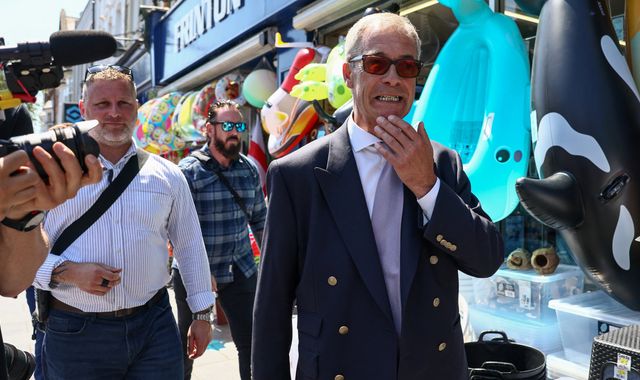
This has not been a good year for Reform's headline polling numbers.
When the party gathered for its 2025 conference, it was topping the polls with shares well above 30%, and MRP projections suggesting this could deliver a Commons majority.
Now Reform has fallen behind Labour, rarely breaks 25%, and a majority looks a long way off.
Reform's average poll share across nine pollsters has dropped by eight points from August 2025 to August 2026, from the low thirties with most to the mid-twenties at best.
This drop is not a short-term blip driven by Andy Burnham's arrival as prime minister.
In fact, Reform's share has been dropping steadily since last autumn, suggesting the party's star was fading well before it faced reinvigorated competition, though the most recent figures show the decline has continued since the change in Labour's leadership.
Yet while Reform have experienced a recent reversal, they remain on track to advance on their last general election showing, when they finished a distant third on 15%, well behind the Conservatives. Reform's current poll average of around 24% is nearly 10 points up on that result.
And though their Downing Street aspirations have taken a knock, Reform remain ahead of the Conservatives as the strongest party on the right - something which looked implausible just two years ago - though the most recent polls have them closing the gap.
So while they no longer top the polls, Reform are still on track to become the first party to disrupt the Labour-Tory duopoly for a century. That's no mean feat.
Leader approval
The news on leader approvals is bad on two fronts here. Reform UK leader Nigel Farage's approval ratings have declined, weighed down by a steady stream of scandal and strife, and this decline has come at the same time as his rivals are reviving.
As Reform headed into their 2025 conference last autumn, an average of 36% of the electorate said they approved of Nigel Farage's performance as leader, while 38% disapproved.
In these cynical times, this marginally negative approval rating counts as a major achievement - at that point, more voters approved of Farage than any other major party leader.
Things look very different now. Only 25% on average now approve of the Reform leader, while 54% say they disapprove.
Both numbers are a problem - Farage no longer attracts sufficient voters to put Reform ahead of its rivals, while his growing toxicity with a majority of the electorate will help opponents mobilise against him.
Nor can this decline be written off as a blip driven by recent hostile coverage about his finances, donations and the company he keeps.
Farage's ratings have been sliding steadily for most of the past year. Reform topped the polls for most of this period, so it seems the more voters contemplated Farage moving into Downing Street, the less they liked the idea.
Even worse for Reform, their leader's implosion has coincided with rebounds for both of his main rivals.
Kemi Badenoch's approval ratings have risen over the past year, while new Labour leader Andy Burnham is currently enjoying a polling honeymoon with positive approvals, and is far more popular than his departed, very unpopular, predecessor Sir Keir Starmer.
Nigel Farage has fallen behind them both.
Things look even worse for Farage when voters are asked to choose who they would prefer as prime minister.
Farage was running Sir Keir Starmer very close on this measure last year, but he now trails Andy Burnham by huge margins. There are two voters who prefer Burnham as PM for every one who prefers Farage.
The Reform leader, long the party's greatest asset, is beginning to look like a liability.
Issues
The issue agenda has been a more positive story for Reform. Immigration is the party's core issue, and all three of the pollsters who regularly track the issues voters focus on - YouGov, MoreInCommon and Ipsos - show it remains one of the top, if not the top, issue concerning voters.
Concern about immigration has continued to run high even as overall immigration levels have fallen sharply, and the numbers of illegal migrants crossing the Channel on small boats have also fallen back.
As arrivals have fallen, Reform have shifted the conversation towards the rights of migrants already in the country, and the polling figures suggest this has succeeded in keeping their core electorate exercised about their strongest issue.
That said, the party are still yet to offer a consistent and coherent message on the cost of living, economic growth and health - three other top voter priorities and topics gaining increasing focus by their political rivals.
Election performance
Reform put in an impressive performance in this May's local and devolved elections. The party gained more than 1,400 seats in England's local elections, winning the most council seats for the second year in a row, and taking control of 14 councils.
But despite these gains, Reform fell back somewhat in Sky's National Equivalent Vote, winning 27%, a decline from 32% last year.
Reform won 29% of the vote and 34 of 96 seats in the Welsh Senedd elections, becoming the main opposition to the incoming Plaid Cymru government and pushing Labour into a distant third place.
In Scotland, Reform won 17% of the regional vote and 17 seats, tying with Labour as the largest opposition party.
These showings in Scotland and Wales far outstrip anything achieved by Farage's previous party UKIP in earlier devolved contests.
But Reform fell short in the biggest contests of the past year.
They came second in two by-elections for Westminster seats - losing to the Greens in Gorton and Denton, then to Labour in Makerfield, where they hoped to disrupt Andy Burnham's return to Westminster. Then they came second again in the by-election to replace Burnham as Greater Manchester Mayor.
A concerning pattern emerged in these contests - Reform's vote went up sharply, but this was not enough to win, as a larger anti-Reform vote coalesced behind the party best placed to defeat them.
Potential Reform victories seem to mobilise the party's opponents as much as its supporters, encouraging large-scale anti-Reform tactical voting.
This was even evident in the recent Clacton by-election, triggered by Reform leader Nigel Farage in his own seat.
While Farage won comfortably, he faced no major party competition, and despite this, anti-Reform voters nonetheless coalesced behind the novelty candidate Count Binface, whose 27% share was by some margin the highest recorded by a satirical candidate in electoral history.
Overall
This has been another remarkable year for Reform UK, a party which has only existed for less than a decade and started standing full slates of candidates in the last couple of years.
Reform led the polls for much of the last 12 months and made record gains in England, Scotland and Wales this May, a sweeping advance which helped hasten the demise of Keir Starmer as prime minister.
If 2025 was the year Reform emerged as a real contender for office, 2026 consolidated the party's status as the strongest challenger to the Westminster Labour government, and the main challenger to nationalist governments in Cardiff and Edinburgh.
But the past year has seen Reform slide back on several fronts.
The party has fallen in the polls and lost its lead to a reinvigorated Labour party. The public have turned strongly against Reform leader Nigel Farage, whose approval ratings are now far behind his rivals.
Reform have weakened in local elections and failed to win any of the biggest by-elections of the past year, as anti-Reform voters mobilised to shut the party out. Reform have become more polarising as they have become more prominent.
The party continues to make the political weather as Labour's strongest current challenger. But Nigel Farage and his party still have a lot of work to do to convince sceptical voters they are ready for government.
This is the first in a series of posts reviewing the polling and electoral performance of the parties as they gather for their annual conferences

(c) Sky News 2026: Is Nigel Farage shifting from Reform's greatest asset to polling liability?

 Met Police chief 'flabbergasted' by release of knife and gun crime suspects on bail
 HMRC threatened with legal action over Israeli settlement trade
 1970s sitcom star Richard O'Sullivan dies at 82
 Police given 40 potential names for woman found at Liverpool park inside bin bag
 Mike Dean admits he tried not to blow whistle during Premier League matches as a 'game'




 On Air