
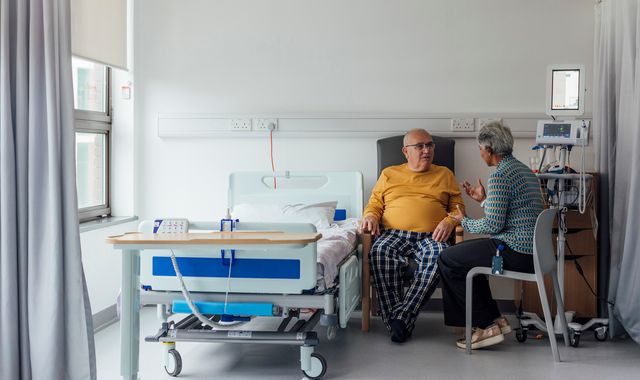
Improvements have been made to the NHS waiting list over the past year, but there are still inequalities between different ethnicities and deprivation levels.
The difference between wait times for the most and least deprived groups has narrowed slightly as the government made progress towards its target that fewer than 8% of patients should wait longer than 18 weeks for treatment.
But analysis by the Health Foundation, an independent health policy charity, found the differences are more pronounced in some areas compared with others.
In Kent & Medway, for example, the gap is almost 10 percentage points – about a third of NHS patients in the richest parts of the area waited longer than 18 weeks for treatment between February and April this year, compared with 43% of those in the worst-off neighbourhoods.
In three areas out of 35 – northeast London, southwest London, and Nottingham and Nottinghamshire – waits were shorter for people in more deprived areas.
The longest waits overall were in Essex. People in the best-off parts of the county wait longer for NHS treatment than people in the most deprived parts of anywhere else in the country.
The government met their interim target that fewer than 35% of patients would wait longer than 18 weeks for treatment as of March 2026, as they target getting that figure down to 8% by the end of the parliament. But they are still missing targets for cancer and A&E waits, and the number of trolley waits remains at record highs.
Read more
Wes Streeting claims he hit his NHS targets - this says otherwise
The charts that tell us why Starmer resigned
Longer waits for South Asian patients
There are also significant differences when it comes to ethnicity. People from a South Asian background wait longest on average, while white patients are typically seen most quickly.
However, the gap between white patients and those from a Black African or Caribbean background has narrowed.
Previous analysis by health thinktanks like the King's Fund and Nuffield Trust said obstacles to care for people from Asian backgrounds are partly down to cultural differences in terms of understanding the best ways to interact with the health system in order to be seen quicker. There is also a language barrier in some cases.
Differences depending on type of treatment
The differences are more pronounced with certain types of treatment. In trauma and orthopaedic cases, for example, the gap in wait times between different ethnic groups is almost zero.
But there is a gap of almost 10 percentage points when it comes to dermatology – 46% of South Asian patients and 43% of Black patients waited longer than 18 weeks between February and April this year, compared with just 37% of white patients.
Read more:
What's it like to give birth in your area
Inside UK's maternity system
The Health Foundation say that part of this is because more serious cases, like some types of skin cancer, are more prevalent among paler-skinned populations. More serious cases are prioritised for treatment, so wait times tend to be shorter.
White people in the UK are also older on average than those of other ethnicities, which can also make a difference in terms of how much of a priority each case is given.
But previous work by the Networked Data Lab, a collaborative network of analytical teams led by the Health Foundation, found that inequalities remain even after adjusting for age.
The Data and Forensics team is a multi-skilled unit dedicated to providing transparent journalism from Sky News. We gather, analyse and visualise data to tell data-driven stories. We combine traditional reporting skills with advanced analysis of satellite images, social media and other open source information. Through multimedia storytelling we aim to better explain the world while also showing how our journalism is done.

(c) Sky News 2026: Patients in deprived areas wait longer for NHS treatment, new figures reveal

 Man convicted of killing British tourist with single punch to be extradited to Greece
 Parts of England have recorded longest spell without rain since mid-1990s, figures show
 Suspect arrested as part of murder probe after man's body found in Cumbernauld property
 Glasgow mother with incurable brain cancer treasuring every moment with young sons
 Prostate cancer treatment with fewer side effects 'as effective as radiotherapy and surgery'






 On Air